Pure Digital's Simon Fleming-Wood(Flip video camera) defines quality entirely in terms of ease of use. He says "We will always prioritize accessibility over features".
This appears in the Wired article 'The Good Enough Revolution: When Cheap and Simple is Just Fine'.
The article says much that is not new. Which? magazine has been banging on for a long time about how people like VW Beetle (original not retro) technology and dislike 'featuritis'. However, it has some interesting observations about the potential for mini-clinics, which I suspect that the current NHS plans will not realise for us in the UK
We need some tools to be able to relate Quality In Use to price point; the usability community has kept itself 'pure' by ignoring the framing that price brings.
Monday, 31 August 2009

Augmented reality
 Presselite has an iPhone app that combines information from google maps, GPS and the camera to give an augmented picture. The photo above shows a MacDonalds icon for the branch across the road. The image comes from a YouTube video that demonstrates the need for an anti-reflection coating on the iPhone. There was a time when my wife worked on military applications of this kind; the idea that you could just download them onto a phone was beyond imagining then.
Seero is a website for geo-broadcasting, which is an interesting development with lots of practical applications - the emergency services, for example.

However, my favourite is a mash-up by a Mr McQueen, of a car chase. He can drive, but has an odd spelling of Bullitt. Worth watching again just for the sound track. Purely in the interests of research, of course.
Saturday, 29 August 2009
User Value

In a fairly heavy piece in IDJ, Suzan Boztepe has a very nice graphic on categories of user value, copied above. A mapping to QIU would not be difficult; her scheme adds considerable richness, and is clearly the result of a lot of thought and analysis.
My favourite website
 No one belongs here more than you by Miranda July.
Just follow the pink arrows at the bottom right. You didn't need me to tell you that.
Functional Surprise
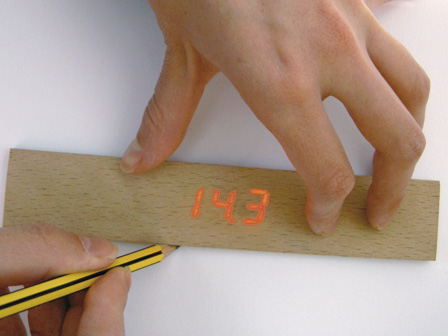 From the Design Reaktor project in Berlin, comes the electronic ruler.
They say:
"The Digital ruler is a 15 cm wooden ruler, which uses technology of electric-resistance and measurement in order to calculate length of line or distance. Unlike any other ruler, it is relative, not absolute. The 0 point of the ruler is defined by every new measurement with any pen. Electronic Ruler is a functional surprising object, offering new ways of using an old device."
Starts to put paper charts on a par with electronic ones. We need more functional surprise.
Friday, 28 August 2009
Thinkin' about the future
Courtesy of Engineers without Fears, I found Katie Chatfield's visualisations of a talk by Bruce Sterling.

The talk is good (though quite long). However, I think the visualisations do more than convey the talk, and can be looked at quite quickly. Favela chic does not really appeal, I'm afraid. (Actually, the latter part of the Bruce Sterling talk had some very interesting insight and advice about what we should do as individuals, but this did not relate to 'where did the future go?')
Courtesy of Tony Collins, I read a piece on NHS IT's local future. The whole piece is good, but this extract shows that there are some signs that the wider context of use is starting to be recognised.
The talk is good (though quite long). However, I think the visualisations do more than convey the talk, and can be looked at quite quickly. Favela chic does not really appeal, I'm afraid. (Actually, the latter part of the Bruce Sterling talk had some very interesting insight and advice about what we should do as individuals, but this did not relate to 'where did the future go?')
Courtesy of Tony Collins, I read a piece on NHS IT's local future. The whole piece is good, but this extract shows that there are some signs that the wider context of use is starting to be recognised.
...The Tories made headlines recently by proposing personal health records - allowing patients easily to access, alter and control information about their own health on the internet.
Integrating a user-friendly interface with the rest of the NHS, as suggested by their name-checking of Microsoft and Google as potential providers, is likely to be some way off.
But many in health IT are convinced a solution must be found to enable the level of preventive and self care required to balance the NHS books in coming years.
Great Ormond Street’s work with children with rare and complex long term conditions often requires many parties, from families to a large range of health and social care professionals, to be kept informed.
David Bowen [of Great Ormond Street] says it had spent a long time looking for technology to aid the process but had found little inspiration within the NHS, and in the end turned to other sectors.
It is hoping systems such as corporate social networks will allow a set of authorised individuals to quickly contribute to and share information about a patient.
He says: “The implications of this are terrific. If we are going to afford healthcare in the future then patients and families have to do a lot for themselves.”
We know from Drucker that the customer is the place to start organisational change.
The Cognitive Edge community has a number of people involved in health care, because it has to change on funding grounds.
Tuesday, 25 August 2009
Boundaries of acceptable performance
Paul Shanahan congratulated me on my 'courage' (cf. 'Yes Minister') in using the original version of Rasmussen's 1997 contours of safe operation diagram. He was right, the diagram is very hard to communicate. Rob Miles has used Venn diagrams in a way that complemented Rasmussen's contours, and so I have devised some Miles-Rasmussen diagrams to illustrate the effects of technology, management and regulation.

In the first instance, the operating envelope is bounded by the limits of Crew Resource Management, business performance, and safety (plus environment and security). Note that this last limit is blurred, unlike the others. Going outside the operating envelope results in unsafe operation, crew overload or unacceptable business performance.
The sales pitch for technology

The sales pitch for technology is that it extends the boundary for safety, giving an extension to the operating envelope, and "look how small the unsafe operation area is now". This is of course nonsense.
Technology is probably neutral, and can be visualised as just making the whole space bigger. This does not mean that actual operation is safer; it might stay at the boundary of safe operation, but with improved business performance.

Generative management

Generative management (cf. Ron Westrum) does increase the operating envelope; this picture ties in with Rob Miles' diagrams showing that good management does not see safety and business performance opposing each other.
Zealous regulation

Tightening regulation (with everything else staying the same) leads to a smaller operating envelope and a big increase in the potential for 'violations'.
There is some more to come on how 'nudge' regulation could be made to work via the internet. Not today, though.

In the first instance, the operating envelope is bounded by the limits of Crew Resource Management, business performance, and safety (plus environment and security). Note that this last limit is blurred, unlike the others. Going outside the operating envelope results in unsafe operation, crew overload or unacceptable business performance.
The sales pitch for technology

The sales pitch for technology is that it extends the boundary for safety, giving an extension to the operating envelope, and "look how small the unsafe operation area is now". This is of course nonsense.
Technology is probably neutral, and can be visualised as just making the whole space bigger. This does not mean that actual operation is safer; it might stay at the boundary of safe operation, but with improved business performance.

Generative management

Generative management (cf. Ron Westrum) does increase the operating envelope; this picture ties in with Rob Miles' diagrams showing that good management does not see safety and business performance opposing each other.
Zealous regulation

Tightening regulation (with everything else staying the same) leads to a smaller operating envelope and a big increase in the potential for 'violations'.
There is some more to come on how 'nudge' regulation could be made to work via the internet. Not today, though.
Subscribe to:
Posts (Atom)

 Posts
Posts

